L'étourdit
2025
Film Production
3D • 2D • Animation • VFX
I created the special effects and animations for the feature film L’étourdit, directed by Paris Lavidis, a brilliant Ph.D. student supervised by philosopher Slavoj Žižek. The film is based on a seminal text by Jacques Lacan, an incredible French psychoanalyst who offered one of the most influential interpretations of Freud’s work through the lens of language and mathematics. The film transforms the theoretical text into a narrative centered on a one-night stand between a man and a woman and its aftermath. According to Lacan, the structures of language make us sexual beings. This means that, for humans, sexuality is displaced in specific ways, which Lacan maps out through the mathematical discipline of topology. My role was to visualize these structures as they manifest in the couple’s encounters.
Using Blender and After Effects, I moved beyond purely aesthetic design and engaged in a rigorous yet creative process. Following Lavidis’s lead, I used accurate mathematical formulas to model and animate the torus, Möbius strip, and cross-cap, which Lacan used to map the topology of the subject. I managed the entire pipeline, animating the intricate transitions between these objects to depict the shifts in the relationship, did the final rendering and prepared the preliminary compositing and handoff to color grading and final composition.
For Jacques Lacan, topology—the mathematical study of flexible shapes and surfaces—is not an illustration1, but a precise way to (de-)monstrate how language structures human experience. More specifically, it monstrates [montrer] how the signifier, in its interaction with the body, functions as the transcendental condition of any experience pertaining to humans, who are speaking beings [parlêtres].2 Topology allows Lacan to monstrate this conditions structure without relying on the deceptive register of the Imaginary and its illusions of intuitive (mis-)understanding3; simply put, there is nothing „relatable“ in a topological surface.4 Most importantly, topology (re-)presents the signifier not as a simple container with a rigid inside and outside.5 Instead, Lacan uses non-orientable topological models—such as the torus and the Möbius strip—to monstrate how the conscious and the unconscious are continuous, inaugurated and structured as such through cuts and holes.5 For Lacan, topology has a certain, strange materiality [l’étoffe] that neither illustrates nor describes the cause in the unconscious, but is truly of the same substance as the unconscious itself: the letter.
1. Lacan, Jacques. Seminar XVI: From an Other to the Other (D’un Autre à l’autre), 1968–1969. Translated by Cormac Gallagher. Unofficial transcript.
2. Lacan, Jacques. Seminar XXII: R.S.I., 1974–1975. Translated by Cormac Gallagher. Unofficial transcript.
3. Lacan, Jacques. Seminar X: Anxiety, 1962–1963. Translated by Cormac Gallagher. Revised by Mary Cherou-Lagreze. Unofficial transcript.
4. Lacan, Jacques. Seminar XII: Crucial Problems for Psychoanalysis, 1964–1965. Translated by Cormac Gallagher. Unofficial transcript.
5. Lacan, Jacques. Seminar XVI: From an Other to the Other (D’un Autre à l’autre), 1968–1969. Translated by Cormac Gallagher. Unofficial transcript.
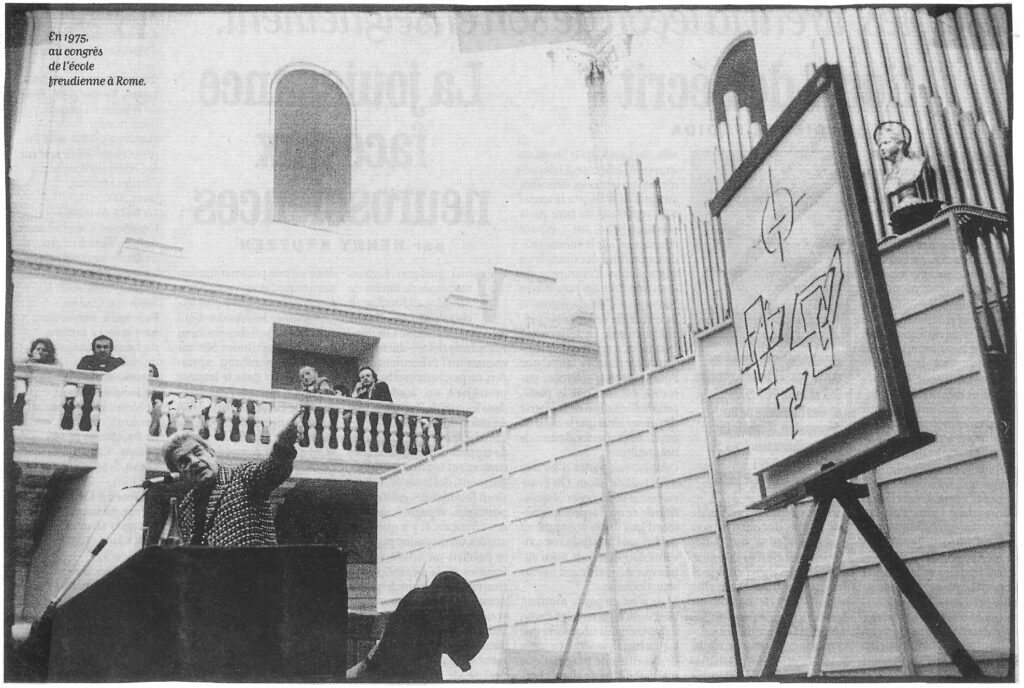
Jacques Lacan presenting La Troisième (The Third) at the Seventh Congress of the École freudienne de Paris in Rome, 1 November 1974, with hand-drawn topological diagrams.
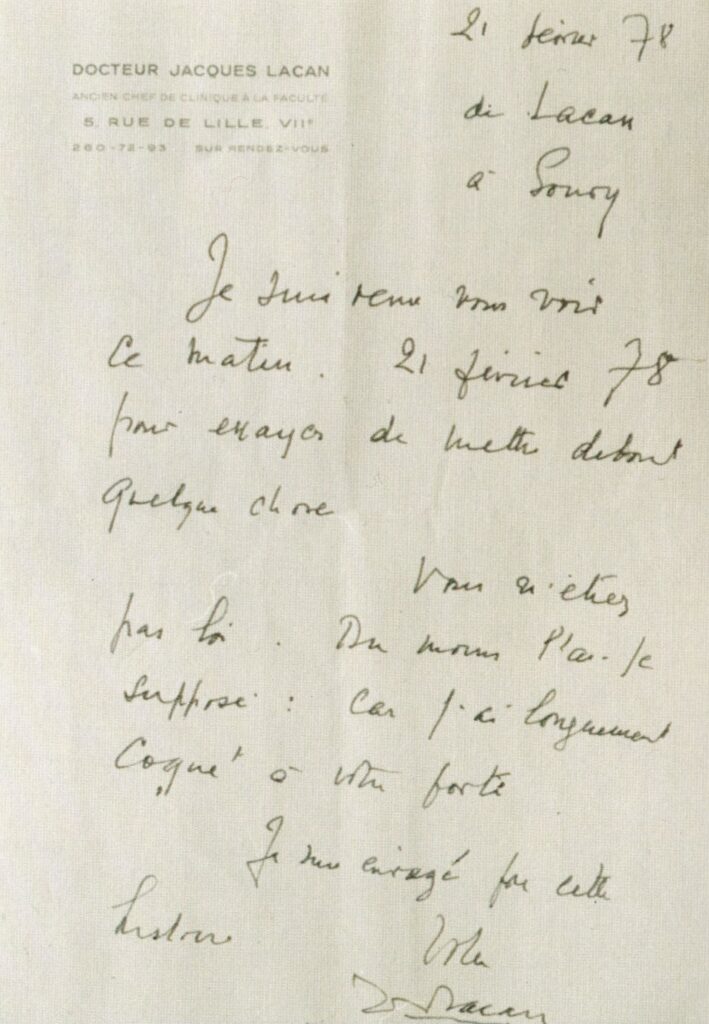
Jacques Lacan, Letter to Pierre Soury, 21 February 1978. “This morning, 21 February 1978, I came to your place in an attempt to work something out. You were not there. At least, that is what I assumed, since I knocked on your door for a long time. This whole business is driving me mad.”
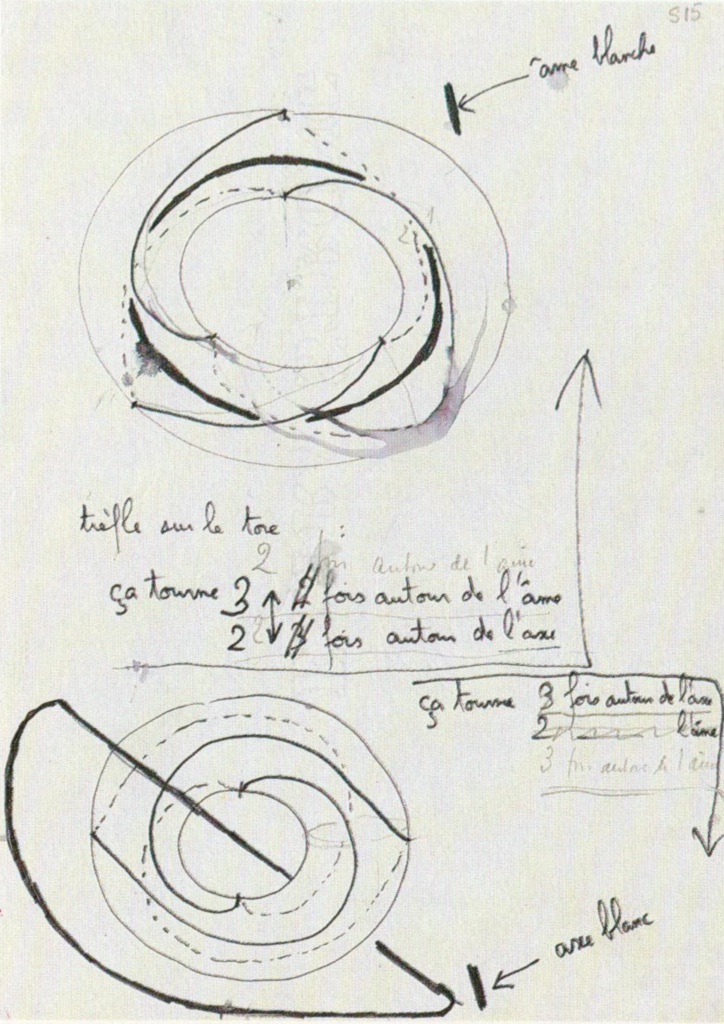
Letter from mathematician Pierre Soury to Jacques Lacan. Two representations of a trefoil knot.
Excerpt from an animation of the Torus in the film, set in a fully abstract space
1. Lacan, Jacques. Seminar XXII: R.S.I., 1974–1975. Translated by Cormac Gallagher. Unofficial transcript.
2. Lacan, Jacques. The Seminar of Jacques Lacan, Book XX: On Feminine Sexuality, the Limits of Love and Knowledge (Encore), 1972–1973. Edited by Jacques-Alain Miller. Translated by Bruce Fink. New York: W. W. Norton & Company, 1998.
3. Lacan, Jacques. Seminar IX: Identification, 1961–1962. Translated by Cormac Gallagher. Amended by MCL, 2011. Unofficial transcript.
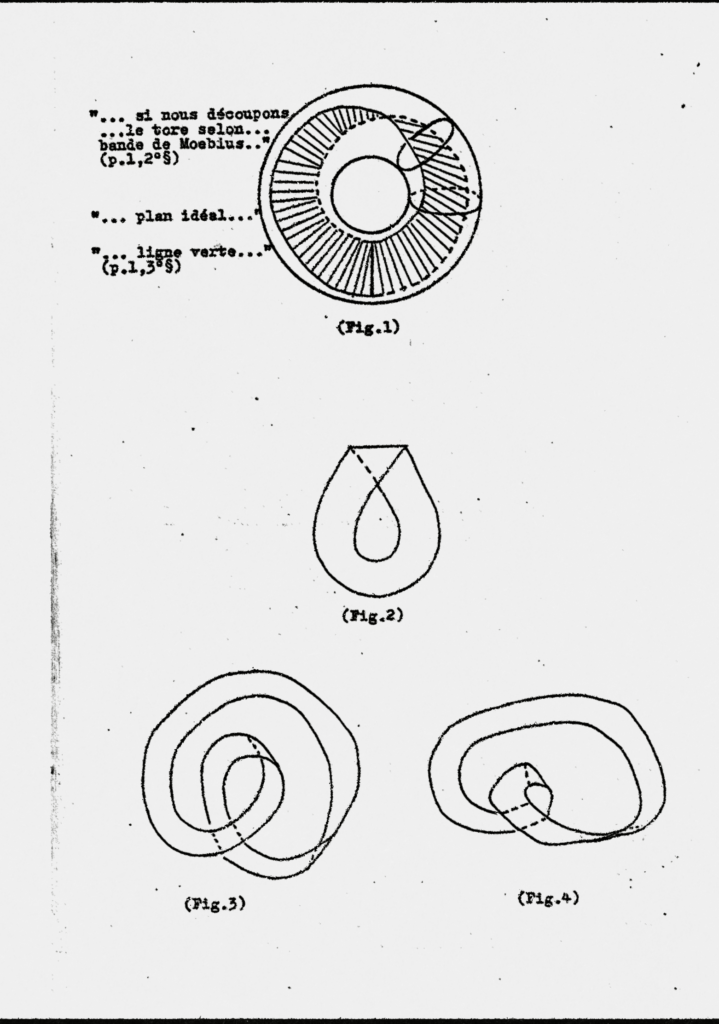
Jacques Lacan, Séminaire XXIV: L’insu que sait de l’une-bévue s’aile à mourre, session of 21 December 1976. Seminar notes featuring a topological diagram relating to the structure of the subject and the relations among the Real, Symbolic, and Imaginary.
Cutting a torus along the demand loop reveals a Möbius strip edge and an inner 8 body.
1. Jacques Lacan, The Seminar of Jacques Lacan, Book XIII: The Object of Psychoanalysis (1965–1966), trans. Cormac Gallagher (unpublished transcript), Session V (January 5, 1966), 67–72
2. Jacques Lacan, The Seminar of Jacques Lacan, Book X: Anxiety (1962–1963), trans. Cormac Gallagher (revised transcript), Session III (November 28, 1962), 27
3. Lacan, Book XIII: The Object of Psychoanalysis, Session VI (January 12, 1966), 72–75.
4. Lacan, Book X: Anxiety, Session IV (December 5, 1962), 29–31
5. Lacan, Book XII: Crucial Problems for Psychoanalysis, Session of June 2, 1965, 364
more to come